Scaling AI Image Generator Through Trust and Relevance
AI Image Generator enables marketers to launch highly engaging ads in minutes. My focus was building trust between users and AI, and enabling success across multiple touchpoints in the marketer journey.
Role
UX lead
Areas
Building trust with AI
B2B2C
Growth
User journey
Strategy and vision setting
Year
2024 (10+ UX launches)

Product size and position editing, launched May 2024

Prompt guidance, launched July 2024

1-click suggested images, launched Sep 2024

Personalized recommendations, launched Nov 2024
PROBLEM STATEMENT
-
Advertisers don’t trust AI. The generated images are “so close”, but still fall short.
-
Most advertisers never discover or try Image Generator.
-
Recommendations feel generic, advertisers don’t see how they support their goals.
APPROACH
-
Build trust through co-creation. Give back control and transparency in the creative process.
-
Meet advertisers where they are. Expand beyond a single tool by designing across the user journey.
-
Adopt a B2B2C lens by grounding recommendations in end-customer needs.
IMPACT
-
23× growth in active advertisers (2K → 46K) in one year
-
+39% campaign submissions
-
$800K → $7M in monthly AI-generated ads revenue
-
+5% lift in average product sales
Background
Limited creative resources have long constrained advertising growth, making it harder for brands to attract shoppers and express their identity. To address this pain point, we launched Image Generator at the end of 2023, enabling brands to easily create product-centric ad images.

AI Image Generator MVP launch video, Nov 2023
Vision and Objective
The vision for Image Generator is to empower any advertiser to create highly engaging ads in minutes.
After launching the MVP, our direction was clear: grow and scale. We set an ambitious goal to increase active advertisers using AI-generated images from 2,000 in Q4 2023 to 50,000 by Q4 2024.
Process
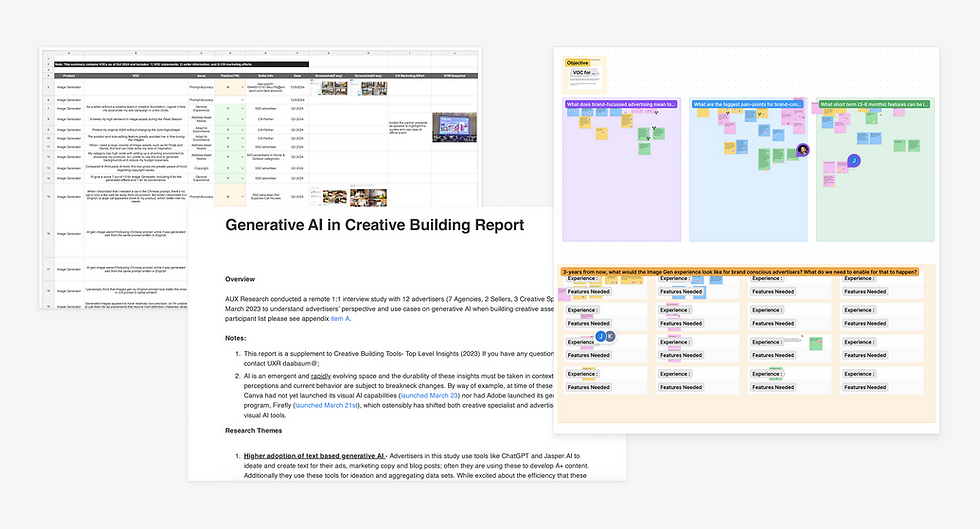
User interviews, survey and workshop, Dec 2023

Design thinking workshop led by me, Jan 2024
“I don’t want the product to look like it’s one size when it’s actually bigger or smaller—that feels like false advertising. That’s why I was hesitant to launch, mainly because of sizing.”
“You already know what the product is, so even a simple suggestion, like trying it on a bathroom counter, would help me start—and I can always adjust it.”
“That would be great, because sometimes everything looks perfect except for one weird, distracting thing. Like if I could just say like please remove the random dragon that you put here.”
Quotes from user interviews
CHALLENGE
Advertisers don’t trust AI. The generated images are “so close”, but still fall short of their quality bar.
Strategy: Co-creation between users and AI
To foster co-creation between users and AI, I designed guidance and editing frameworks that put control back in users’ hands.

Editing framework, Mar 2024

Designing for error prevention and micro-interaction, Mar 2024

Product size and position editing feature, launched May 2024

Guided prompt feature, Launched July 2024
Post-launch engagement was strong, with 45% of saved images edited and 29% of advertisers using guidance. Among visitors to the tool, image adoption grew from 23% to 40% month over month.
CHALLENGE
Adoption was growing, but not fast enough—putting our goal at risk.
While about 200,000 advertisers submit campaigns each month, only 10% ever open the tool. That gap led me to zoom out and look at the user journey.

Advertiser journey, July 2024
What if marketers could instantly access the right images and launch ads in minutes—without creating them?

1-click suggested images, launched Sep 2024
Stepping back further, what about the other touchpoints across their journey?
I began exploring multiple touchpoints across the marketer journey and partnered with a researcher to validate the ideas.
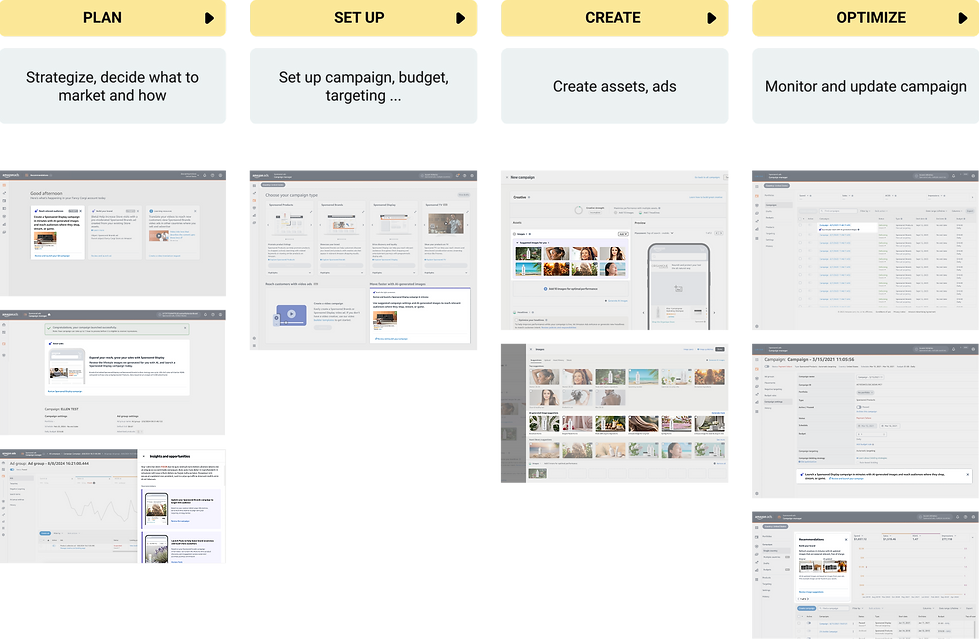
Exploring multiple touchpoints in user journey, Aug 2024


User interviews + testings, conducted Aug 2024
“How does this help me sell more stuff?”
“I just don’t consider Amazon as a brand building destination. ”
“I don’t see the value of investing in upper funnel ads like image ads.”
“I don’t know why I’m seeing this.”
“It feels too generic.”
“Preset campaigns with AI images? I don’t know if I can trust that.”
User quotes from research, Aug 2024
CHALLENGE
Advertisers face significant mental barriers to adopting recommended AI images for new launches, with trust foremost, followed by misalignment with marketing goals.
To build long-term trust, I decided to start small—shifting focus from new campaign launches to personalized, timely, and contextual recommendations for campaign updates.
Personalized recommendations, launched Nov 2024
In a B2B2C model, success lives with the end customer.
By grounding recommendations in shopper needs, we helped advertisers select images aligned with their goals—surfacing creatives tailored to seasonality and specific shopper segments.


Images targeting different shopper segments
Images targeting different time of the year
Results
Within one year of launching Image Generator, as the sole UX lead, I partnered with Product, Engineering and Science on launching a series of new features and improvements, we’ve seen
Active advertiser adoption
2k 46k
Campaign submissions
+39%
Product sales
+5%
“2024 was a breakout year for Image Generator. We grew from 2,000 to 47,000 advertisers, and today 20% of image ads use AI-generated creatives—delivering real value and setting us up for DCO and video generation in 2025.”
– Jay Richman, VP at Amazon Ads
“As a seller without a creative team or creative foundation, I agree it help me accelerate my ads campaign in a few clicks.”
– Seller, small business owner
"My category has high costs with setting up a shooting environment to showcase my products. So I prefer to use this tool to generate backgrounds and reduce my budget expenses."
– Seller, small business owner
“When I need a large volume of image assets, such as for Posts and Stores, this tool can help solve my lack of inspiration.”
– Seller, big brands
Feedback from leadership and customers
Coming next
Next is a shift to a creative-first mindset, where creative exploration leads, not follows. We imagine a standalone creative hub powered by more expressive and intelligent AI, one that goes beyond generating assets to inspiring ideas, shaping narratives, and supporting increasingly complex advertising needs. In this future, AI becomes a true creative partner, helping advertisers move fluidly from intent to expression, and unlocking new possibilities for storytelling at scale.


Inspiration gallery, launched Nov 2024

Agentic AI tool, launched Sep 2025
Reflections
This project reinforced that trust is foundational when designing with AI—without it, even strong capabilities don’t translate to adoption. It also required constant nimbleness, as priorities shifted alongside model readiness and the rapid evolution of AI.
I learned that meaningful impact comes from looking beyond a single tool to understand the full user journey, and beyond advertisers to the people they serve. This perspective reflects how I approach design overall: designing for human journeys, not just moments. As I look toward the future, I’m drawn to problems where empathy, context, and trust are essential to supporting people in high-stakes, deeply human moments.